The Future of Global Payments Is Stablecoin-Powered: Why Banks Are Racing to Acquire Payment Infrastructure
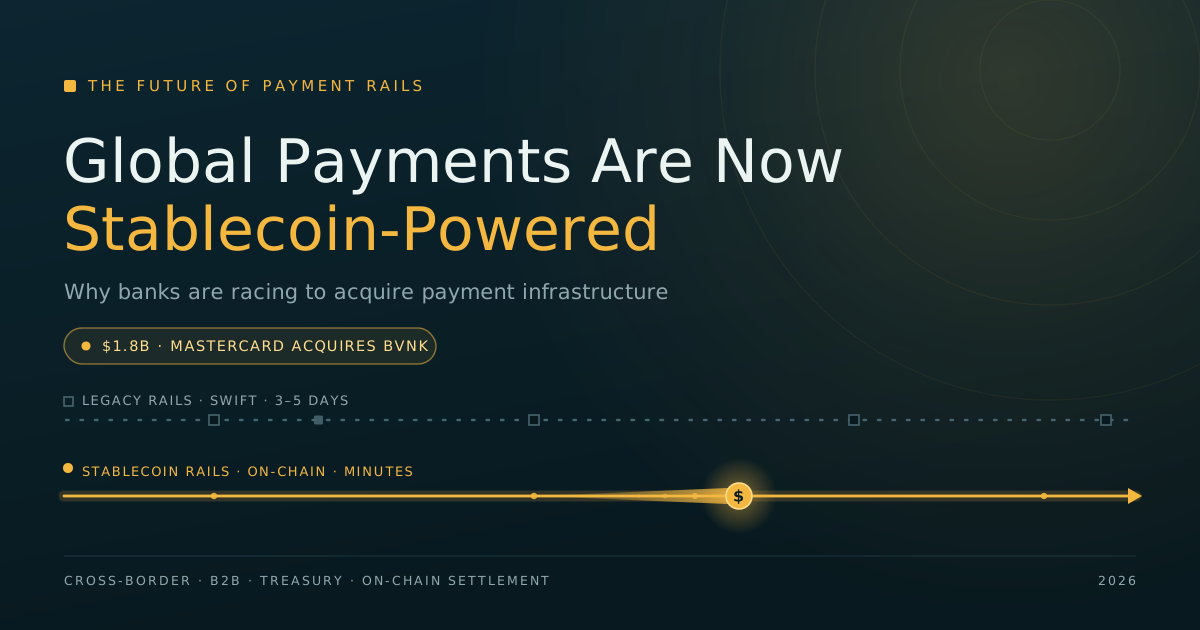
Quick answer: Stablecoins have graduated from a crypto trading tool into a serious global payments rail — and the biggest names in finance are now paying billions to own the infrastructure behind them. In August 2026, Mastercard completed its acquisition of stablecoin firm BVNK for up to $1.8 billion. The logic is simple: stablecoin cross-border payments settle in minutes for a fraction of a percent, while a traditional SWIFT wire still takes days and costs 2–7%. This is the story of why the race for stablecoin payment infrastructure is on, backed by the latest data, and where payment rails go from here.
Key takeaways
Mastercard acquired BVNK for up to $1.8 billion (including $300 million in contingent payments), completing the deal on August 3, 2026, to connect its card network to on-chain settlement.
The stablecoin market sits at roughly $308 billion as of mid-August 2026 (DefiLlama), up about 14% year over year, with USD-pegged tokens making up ~99.5% of supply. Stablecoin settlement can be 100x–1,000x cheaper than a SWIFT wire and clears in seconds, 24/7. B2B stablecoin payments hit $226 billion in 2025, up 733% year over year, according to McKinsey. JPMorgan, Citi, Bank of America and Wells Fargo are building a shared tokenized-deposit network (targeted for 2027) to defend their deposits from stablecoin flight. Citi projects the stablecoin market could reach $1.9 trillion (base case) to $4 trillion (bull case) by 2030.
Why did Mastercard acquire BVNK? Mastercard acquired BVNK to own the plumbing that connects traditional card rails to blockchain-based money. Announced in March 2026 and completed on August 3, 2026, the deal was worth up to $1.8 billion, and it is the payment network's biggest bet yet on digital currencies going mainstream.
BVNK is a London-founded stablecoin payment infrastructure firm that lets businesses hold, move, and convert value across both fiat and stablecoins, sending and receiving payments across major blockchain networks in more than 130 countries. Its rails already power heavyweight fintechs including Worldpay, Deel, Rapyd, and Flywire. Early backer Concentric first invested in 2019 at a valuation of just $4 million — a reminder of how fast this category has compounded.
The competitive heat is telling. BVNK reportedly fielded interest from Coinbase and Visa as well, ultimately choosing Mastercard. Once integrated, BVNK will power 24/7 stablecoin settlement for processors and acquirers, and add stablecoin checkout to Mastercard's payment gateway.
Mastercard's chief product officer, Jorn Lambert, framed the strategy around a "multi-money world" in which fiat, stablecoins, and tokenized deposits coexist — and the winning payment network is the one that connects every rail. That single sentence explains why fiat and stablecoin interoperability, not one rail beating the other, is the real prize.
What are stablecoins, and why do they matter for global payments? A stablecoin is a digital token pegged to a stable reference asset — almost always the US dollar — that moves on public blockchains. Because the value stays flat while the settlement is on-chain, a stablecoin behaves like tokenized money: dollars you can send peer-to-peer, around the clock, without waiting on a chain of intermediary banks.
That combination is why stablecoins are suddenly central to cross-border settlements, treasury payments, and B2B payments. Global commerce runs 24/7, but the correspondent-banking model behind most international transfers does not. Stablecoin settlement collapses multi-day, multi-fee wire chains into a single on-chain transfer that finalizes in seconds.
Crucially, most businesses never touch crypto directly. The dominant pattern is the "stablecoin sandwich": fiat in, stablecoin across the border, fiat out — the sender pays in local currency, value crosses on-chain, and the recipient is paid in their own. Neither side manages a wallet; they just get faster, cheaper money movement.
Stablecoins vs SWIFT: the cost and speed gap This is the comparison driving every boardroom conversation. SWIFT, launched in 1973, is a messaging network linking more than 11,000 financial institutions and handling roughly 45 million payment messages a day — but it routes instructions between correspondent banks rather than moving the value itself.
| Factor | SWIFT / correspondent banking | Stablecoin rail |
|---|---|---|
| Settlement time | 3–5 business days | Under 3 minutes, 24/7/365 |
| All-in cost | 2–7% (fees + FX spread) | ~0.1–0.5% |
| Per-transfer fee (benchmark) | $25–$50 (BIS) | $0.01–$1.00 (US Federal Reserve) |
| Availability | Banking hours | Always on, weekends included |
| Intermediaries | 2–5 correspondent banks | Peer-to-peer |
| Transparency | Opaque; hidden FX markups | On-chain, auditable |
| Programmability | None | Smart-contract native |
The headline: on most cross-border flows, the cost ratio runs 100x to 1,000x in favor of stablecoins, per Federal Reserve and BIS benchmarks. The gap is widest in emerging markets, where correspondent banking is most broken. Corridors into India, Nigeria, Brazil, Argentina, the Philippines, Turkey, and Pakistan consistently show 50–70% cost savings versus traditional rails, and Sub-Saharan African remittances still average over 6% in fees, according to the World Bank.
One honest caveat keeps this credible: stablecoins are not a universal SWIFT replacement. SWIFT still wins where local regulation limits crypto, where offramps are thin, or where very large flows need established correspondent relationships. The realistic 2026 picture is coexistence — a multi-rail model where treasury teams route each corridor to whichever rail is cheaper and faster.
How big is stablecoin adoption right now? The numbers show a market that has decoupled from crypto speculation and anchored itself to payments.
Total supply: roughly $308 billion as of mid-August 2026 (DefiLlama), up 14.3% year over year from about $269 billion a year earlier. The market peaked near $321 billion in April 2026, so it is holding close to record highs. (Different trackers vary by a billion or two, so always cite the source and date.) Concentration: Tether's USDT holds ~59% of supply; Circle's USDC is #2. Together the top two account for roughly 83% of all stablecoins. Reach: an estimated 269 million on-chain addresses hold a stablecoin balance as of mid-2026. Payment volume: McKinsey put 2025 stablecoin payment volume at $390 billion, more than double 2024. Within that, B2B payments reached $226 billion (up 733% year over year) and consumer stablecoin-linked card spending hit $4.5 billion (up 673%). A reality check that separates good analysis from hype: of the tens of trillions of dollars in raw stablecoin "transfers" recorded in 2025, only an estimated $350–550 billion was genuine real-economy payments (BIS, BCG × Allium, McKinsey). Most on-chain volume is still trading and wallet-to-wallet shuffling. But the real-economy slice is exactly the part growing fastest — which is what the acquisitions are chasing.
Why banks are racing: the deposit-flight threat Here is the uncomfortable part for incumbents. If businesses and consumers can hold dollars that settle instantly and cheaply, some of the money that currently sits in bank deposits could migrate to stablecoin wallets. Deposits are what banks lend against — so large-scale stablecoin adoption is not just a payments story, it's a balance-sheet threat.
The unlock was regulatory. The GENIUS Act, signed into US law on July 18, 2025, created the first comprehensive federal framework for payment stablecoins — giving banks and issuers a clear, supervised path. That clarity is precisely why 2026 became the year of stablecoin dealmaking.
The response has come on two fronts. Fintechs and networks are buying infrastructure: Stripe acquired Bridge for $1.1 billion (2024) and built a full stablecoin stack, Visa's stablecoin settlement hit a $4.5 billion annualized run rate by January 2026, and Mastercard bought BVNK. Meanwhile, banks are building their own on-chain money.
Tokenized deposits vs stablecoins: what's the difference? This distinction is central to how banks are adopting stablecoins — often by building something adjacent to them.
A stablecoin is a bearer-style token backed by segregated reserves, redeemable at par, that can circulate publicly wallet-to-wallet across institutions and borders. A tokenized deposit is a digital claim on a specific bank account that moves only inside that bank's permissioned network — the token is the deposit, so it never leaves the bank's balance sheet or its regulated perimeter.
Banks prefer tokenized deposits for a simple reason: the dollars stay on their books, funding loans, while still gaining blockchain speed and programmability. And the GENIUS Act's exclusion of tokenized deposits from stablecoin classification means banks can issue them without a separate stablecoin license.
The live scoreboard as of 2026:
SoFi launched sofiUSD on December 18, 2025 — the first bank-issued stablecoin after the GENIUS Act. JPMorgan runs its Kinexys / JPMD deposit token, which went live on Coinbase's Base network on November 12, 2025 and now handles billions of dollars in daily volume. Citi Token Services is live for corporate clients across the US, UK, Singapore, and Hong Kong. As of Q2 2026, four of the 50 largest US banks have active tokenized-deposit products, with seven more in pilot. The biggest move is collective. JPMorgan, Bank of America, Citigroup, and Wells Fargo are collaborating on a shared tokenized-deposit network, operated by The Clearing House, targeted for 2027. The goal is 24/7 interbank settlement that keeps money inside the banking system — a direct hedge against pending legislation (the CLARITY Act) that could let stablecoins pay interest and accelerate deposit flight.
Stablecoins for B2B and enterprise payments For enterprise finance leaders, the calculation has shifted from "if" to "which corridors." The three use cases where stablecoin economics most clearly beat traditional rails are cross-border supplier payments, intercompany treasury settlement, and contractor payroll — all high-frequency, cross-border flows where correspondent-banking fees and float quietly tax margins.
The scale of savings is concrete. On $10 million in annual cross-border payment volume, moving from 2–7% wire costs to 0.1–0.5% stablecoin costs is worth $200,000 to $700,000 a year. Among businesses already using stablecoins, a meaningful share report double-digit percentage cost savings, mostly on cross-border payments.
For stablecoin treasury management, the appeal goes beyond price. Cash that once sat in multi-day float becomes usable liquidity, reconciliation shifts from manual to real-time, and programmability enables payment orchestration legacy rails can't match — conditional payouts, automated settlement, and 24/7 liquidity across entities.
The future of payment rails: a multi-rail world Put the pieces together and a clear picture emerges. The next era of global payments won't be stablecoins versus banks, or on-chain versus SWIFT. It will be a multi-rail world where fiat, stablecoins, tokenized deposits, and eventually CBDCs coexist, and the winners are the networks that make every form of money interoperable. That is exactly why Mastercard bought BVNK, why banks are building shared ledgers, and why fintechs are racing to acquire stablecoin infrastructure rather than build it slowly.
The trajectory is steep. Citi projects the stablecoin market at $1.9 trillion (base case) to $4 trillion (bull case) by 2030, potentially supporting up to $100 trillion in annual transactions in its base scenario. Standard Chartered sees around $2 trillion by 2028, Coinbase forecasts $1.2 trillion by 2028, and US Treasury Secretary Scott Bessent has pointed to $3 trillion by 2030. Forecasts differ, but the direction is unanimous.
The takeaway for banks, fintechs, and enterprises is the same: stablecoin payment infrastructure has crossed from experiment to production. The institutions racing to own it aren't betting that money moves on-chain — they're deciding who controls the rails when it does.
Frequently asked questions
Why did Mastercard acquire BVNK?
To connect its global card network directly to blockchain-based settlement. The up-to-$1.8 billion deal (completed August 3, 2026) gives Mastercard on-chain, stablecoin-native infrastructure for 24/7 settlement, cross-border B2B payments, payouts, and treasury flows across 130+ countries.
Are stablecoins better than SWIFT for cross-border payments?
For speed and cost, yes — stablecoin transfers settle in minutes at ~0.1–0.5% versus SWIFT's 3–5 days at 2–7%, a 100x–1,000x cost advantage on many corridors. But SWIFT still wins where offramps are thin or local rules restrict crypto, so most treasury teams run both in a multi-rail setup.
How big is the stablecoin market in 2026?
About $308 billion in total supply as of mid-August 2026 (DefiLlama), up ~14% year over year, with USD-pegged tokens making up roughly 99.5% of supply and USDT plus USDC accounting for ~83% of the market.
What's the difference between tokenized deposits and stablecoins?
A stablecoin circulates publicly across institutions and stays off the issuing bank's balance sheet. A tokenized deposit is a claim on a specific bank account that moves only within that bank's network and stays on its balance sheet — which is why banks favor it.
How are banks adopting stablecoins?
Through bank-issued stablecoins (e.g., SoFi's sofiUSD), tokenized-deposit programs (JPMorgan's Kinexys/JPMD, Citi Token Services), and a shared tokenized-deposit network from JPMorgan, Citi, Bank of America, and Wells Fargo targeted for 2027.
What is the GENIUS Act?
US legislation signed on July 18, 2025 that created the first comprehensive federal framework for payment stablecoins, giving banks and issuers a regulated path — the catalyst behind 2026's wave of stablecoin acquisitions.
Want this run on your account?
I take on a small number of performance and SEO engagements at a time.
Let's talk